
Under My Control? The Wisdom to Know the Difference

Share

“…grant me the serenity to accept the things I cannot change; courage to change the things I can; and the wisdom to know the difference…”  from the Serenity Prayer attributed to Reinhold Neibuhr

I’ve referred to the Serenity Prayer before in this previous post.  It’s the “wisdom to know the difference part,” that I want to reflect on today.  As a practicing Stoic, I know that there are many facets of my life that are not in my control.  But how do I know what is and what isn’t?

In his book, A Guide to the Good Life: The Ancient Art of Stoic Joy, William B. Irvine says we have a trichotomy of control:  1) things we can control, 2) things we have partial control of, and 3) things we have no control over.  This is a great idea, it simplifies things.  In reality though, I see my life as a series of things that fall somewhere on a continuum of control.  For every aspect of our lives, there is a portion that we have control over, and a portion that we don’t.   For the sake of analogy, while Irvine pictures a 3-position switch, I tend to see a volume switch (a rheostat) that fate uses to adjust the “control level.”

A volume rheostat…more volume, more control?

There is a continuum of control in just about everything in my life.  Whether or not I will overeat for dinner tonight is completely under my command (unless I were held at gunpoint and told to overeat…still in my control, but less so).  In contrast, whether I will be able to afford a fancy dinner next year is partially in my control, but not completely.  I could unexpectedly lose my job, or inflation could take its toll and it would be too expensive.  Also, I might get really sick and have to make medical payments as well.  So many possibilities by then!  How much or how little I can change my destiny depends on an innumerable number of factors.  I don’t know where that volume switch of control will be next year, but I am certain it won’t be set at “completely mine.”  In any case, my entire day, my future, my end…are largely outside of my jurisdiction…much of it is indeed, fate.

This is great and all, but isn’t the key to serenity knowing what is and is not in your control, and how much?  Knowing this is not easy.  Not only does it require effort, but it requires quite a bit of intellect, no?

Which brings me to another point.  The amount of intellect we have to work with is completely out of our control; basically we are stuck with the brain we have.  However, the amount of effort we make to understand the nature of life…well, THAT is completely under our command.

So, the wisdom to know the difference between what we can and cannot change is two-fold.  Our natural intelligence is what we are stuck with, but our choice to exert effort on determining what we can change is ours to make completely.  There is an irony here:  even the “wisdom to know the difference” is both part in/part out of our control.

In any case, determining these things is very important to see things as they are, which I think is essential to living a virtuous life.  So regardless of the intellect I am given, gaining “the wisdom to know the difference” requires effort and time on my part.  I must take time to reflect on what is truly in my control, and I certainly will have to use the utmost of my reasoning abilities to decipher what I CAN control in my life, and what I must file under “acceptance.”  I see no better way to do this than to meditate and reflect on this frequently.

Lovingkindness: Gandhi, World Peace, and Family Happiness

Share

I woke up this morning ready for a fight.  I had some left over resentment from a disagreement I had with someone very close to me…my lovely wife to be perfectly honest.  All the while, I began to prepare for my next post about lovingkindness.  Oh the Irony!  To write about loving all sentient beings with unconditional love, yet holding back even a little to those close to you.   It doesn’t make much sense does it?   And yet, it happens all the time; while we are severe with those close to us, we put on the “happy” mask and interact with civility and agreement with complete strangers.

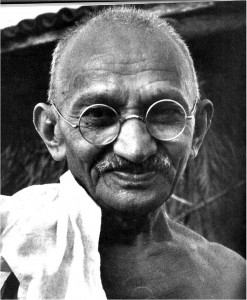
This got me to thinking (yes, here I go again).  Did Gandhi ever just wake up and decide to be a pain in the rear to those around him that day?  This question sent me on an internet journey to find out.  In retrospect, traveling down THAT rabbit hole consumed far too much of my time, but I finished the journey to my liking and learned a thing or two.  As it turns out, I found this internet entry where it explains that, “[Gandhi] was exceptionally demanding of himself, and demanding of those closest to him.  Whereas he displayed loving kindness to virtually everyone, with his family he could be quite severe.” I also found this Wikipedia entry about Kasturba Gandhi, his wife.  While the article was fair, I think you might come to the conclusion that Mr. Gandhi’s domestic life was far from serene.

After even further internet research, I discovered two very important concepts about Gandhi, the peace-warrior:

  1. Gandhi’s family life was very complicated, and it seems no different than many of our own internal family issues.  In fact, it may be that his extreme views and justice efforts made his family worse for the wear.
  2. Don’t go to the Internet for information if you want a straight answer.  There is a lot of unverified and conflicting stuff.

OK, the second one was not really about Gandhi, was it?  In any case, I think I have come to some closure on this Gandhi question.  If my current view of Gandhi is correct, that he spent far more energy on justice for his community than on tranquility in his home, then I do not want to emulate everything about him.  I think he missed a key portion of “how to live” if he did not convey lovingkindness to his wife and children, as he worked for peace in the macro sense.

In fact, there may be some validity in the idea that tranquility and lovingkindness begin at home.  I have often struggled with the concept of how difficult it would be to attain world peace, when I think about how difficult it is for those who are very close (like family) to come to be “at peace” with each other.  Marriage statistics alone tell part of the story.  In the U.S., around 45% of first marriages end in divorce (see http://www.divorcestatistics.org).  This does not even include those who never get married because they gave up, or those who stay married even if their relationship is violent, miserable, or fattening (I just put “fattening” in to see if you were paying attention).  Rhetorically I must ask, how many brothers and sisters don’t speak to each other?  How many father – son relationships are estranged?  Where is the love?

So what is the point, if I should have one?  I think the big take away is that “we” as humans have a long way to go to showing true lovingkindness.  I know “I” certainly do.  How can we show lovingkindness to all those around the world, when there is so much work to do with those we are closest to?  This REALLY seems like bad news!  Indeed, it is the bad news.

Now for the GOOD news!  Because there is such a gap between the kind of lovingkindness we strive to attain and what the reality of the situation is, creating more of it in your life is LOW HANGING FRUIT.  It should be very easy to send out even a little more to those close to us.

Well, as for my agitation with my wife, it’s gone; it was just silly.  In the end, it was more my faulty interpretation of things that really created the problem…I’m over it, except that I’m a little embarrassed about feeling that way.  As for the rest of my day, I am committing myself to conveying lovingkindness to those closest to me.  World peace will have to wait.

I am not worrying about “World Peace” today.

Will you join me?

Low Hanging Fruit

Aside

Share


Low Hanging Fruit –  Phrase that refers to achieving a goal that is easiest to reach.  Certainly it has some roots in the natural state of food gathering.  If you were ancient man or even an ape, you would tend to grab the fruit nearest to the ground rather than climb to the highest point on the tree.  Why put yourself at great risk when you can eat just the same by safely keeping your feet flat on the ground?

Low Hanging Fruit

A common approach in business process improvement is that fixing simple problems first to get immediate gains, provide people with a feeling of victory and motivate them to continue to do better.  “Let’s get the low hanging fruit in our production process first, then we can work on the more complex issues.”

I contend that you can apply this concept in your quest for virtue as well.  More to follow…


Anchor #7: Lovingkindness

Share

Lovingkindness (Metta) is sometimes shortened (even by me) to love.  This is fine; it’s easier to remember, but I think to absorb the true meaning of lovingkindness you have to remember that it is so much more than “love.”

Not this Metta!

Lovingkindness is to wish good will and happiness to all sentient beings.  First and foremost of these are humans…not because they deserve it, but probably because they don’t.  Seriously, when is the last time a bison or a worm ticked you off?  In other words, people can be much harder to express lovingkindness to, precisely because they are so complex.  That darn neocortex (see triune brain)!

In any case, the lovingkindness I focus on is that for those in the human species.  Like compassion or sympathetic joy, you can express it for

  1. Yourself
  2. Those you already love
  3. Those you don’t know
  4. Those you can’t stand
  5. Those you absolutely hate (you know there are a few, yes?)

As soon as you master these five, then maybe you can expand towards all sentient beings.

Lovingkindness is not that Eros kind of love, where the passion is returned.  It is a selfless love extending out as brotherly (remember philia?) love, and then all-embracing unconditional love, possibly an agape (godly) love.

You can meditate and wish lovingkindness to your world, person by person, being by being.

It all starts with a quiet moment and contemplation…

(Feature “Hands” photo by Penny Mathews)

Sentient

Share

Sentient – term used to describe living beings that can experience suffering (as in sentient being).  In Eastern thought this attribute is given to living beings other than humans.  Some lineages of Buddhism take this to the extreme.

An example of this extreme view might be in the movie Seven Years in Tibet, when the monks worked painstakingly and slowly in digging a foundation for their building so that they would not kill the worms that were in the ground.

Much of this Buddhist thought connects with the concept of reincarnation.  In “Seven Years,” the construction worker states, “This worm could have been your mother.”

A kitten could be considered a sentient being.